The Pursuit of Tone
What we talk about when we talk about tone. Reality and perception.
The Truth About Tone: It's Not Your Pickups. It's You.
The endless pursuit of the perfect guitar tone, and why we might be looking in the wrong place.
There are few things guitar players love talking about more than tone. We obsess over it. We chase it. We spend countless hours researching it, listening to it, comparing it, and, perhaps most importantly, spending money trying to find it.
And somewhere along the way, I think we've lost sight of something pretty important.
Your tone isn't in your pickups. It's in you.
Now, before the pickup manufacturers come after me with pitchforks and soldering irons, let me explain. I manufacture guitars. I love guitars. I love pickups. I love amplifiers. I appreciate the engineering, craftsmanship, and creativity that go into all of them. I'm fascinated by the subtle differences between a vintage-style single coil and a modern high-output humbucker. Those differences are real, and they absolutely matter.
But I think we've given the equipment a little too much credit.
Warm, Hot, Bright... What Are We Actually Talking About?
Spend five minutes in a conversation with guitar players about pickups, and you're almost guaranteed to hear a few familiar adjectives.
"This pickup is really warm."
"I wanted something a little hotter."
"Those single coils are too bright for me."
"I'm looking for something with more bite, but I don't want it to sound muddy."
And, of course, there's the ever-popular "vintage tone."
What does any of that really mean?
Sure, there are technical explanations for some of these descriptions. A higher-output pickup can push an amplifier harder. A pickup with a different resonant peak might emphasize certain frequencies. Magnet types, winding patterns, inductance, and resistance can all contribute to how a pickup responds.
But when someone says a pickup sounds "warm," what exactly does that mean? Warm compared to what? A cup of coffee? A fireplace? The pickup they replaced last Thursday?
What's warm to one guitar player might be muddy to another. What's bright to one player might be articulate to someone else. One player's aggressive, punchy tone is another player's abrasive nightmare.
We're trying to describe sound with words that were never particularly good at describing sound in the first place.
And that's okay. Music is subjective. Tone is subjective. We all hear things a little differently, and our musical experiences shape what we consider pleasing.
Which brings me to something I believe is far more important than the specifications printed on the back of a pickup box.
The 90% Rule
Here's my philosophy, and I'm perfectly comfortable admitting that it's not based on some scientific equation.
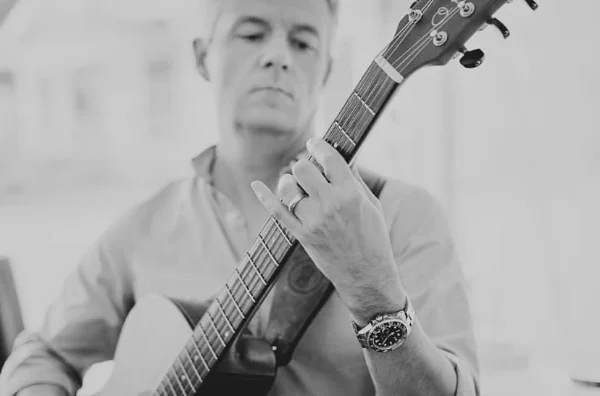
I believe your hands account for about 90% of your tone.
That's right. Ninety percent.
Your pickups, your guitar, and your amplifier can fight over the remaining 10%. I'll let you decide how to divide that up.
Now, obviously, I'm not suggesting that a Telecaster through a clean Fender amplifier sounds identical to a Les Paul through a cranked Marshall. Of course not. Equipment establishes a sonic foundation. It shapes the frequency response, the dynamics, the gain, and the overall character of what comes out of the speaker.
But the equipment doesn't make the music.
You do.
Think about two guitar players picking up the exact same instrument, plugged into the exact same amplifier, with every setting left completely untouched.
They won't sound the same.
Why?
Because one player attacks the strings differently. One uses a heavier pick. One plays closer to the bridge. One has a more aggressive vibrato. One bends notes slightly sharp. One has a delicate touch, while the other practically wrestles the notes out of the instrument.
Their phrasing is different. Their dynamics are different. Their timing is different. Even the way they allow a note to decay is different.
Those are the things that make a guitar player recognizable.
You can purchase the same equipment as your favorite guitarist, but you can't purchase their hands.
We were at a NAMM show one time and a guitarist asked me: "How long will that sustain?" I replied, "Why, how slow do you plan on playing the solo to Comfortably Numb?..."
Your Musical Interests Shape Your Tone
Here's another part of the conversation that I think gets overlooked.
What you listen to has an enormous influence on how you play.
Think about the difference between someone who spent their formative years listening to B.B. King and someone who grew up studying Eddie Van Halen.
Both could play the same guitar through the same amplifier, but their musical vocabulary would lead them in completely different directions.
The notes they choose, the spaces they leave, the way they approach a phrase, and the emotions they're trying to communicate all influence what we ultimately hear as their tone.
I grew up in Southeast, Georgia and I promise you that hearing Ray Charles sing Georgia on My Mind every night at midnight as the television signed off had a HUGE influence on my tone.
You can't hear that sweet voice and not be moved.
A blues player might spend years developing the ability to make a single note speak. A jazz guitarist might focus on the subtle articulation of complex chord voicings. A rock player might develop an aggressive pick attack that makes every note jump out of the speaker.
None of those approaches is inherently better than another.
They're simply different musical personalities.
And those personalities don't come from magnets wrapped in copper wire.
They come from listening, learning, experimenting, and developing a musical identity.
Practice: The Most Overlooked Piece of Equipment
Here's where I might upset a few people.
I think some guitar players spend more time researching equipment than actually playing their guitars.
We live in a world where you can spend an entire evening watching pickup comparisons on YouTube. You can listen to A/B demonstrations, read hundreds of opinions on forums, study winding specifications, and debate whether Alnico II or Alnico V magnets are the secret to some legendary recording.
And there's nothing wrong with being curious. I enjoy those conversations myself. Okay... some of them... but in moderation.
But at some point, you've got to ask yourself a question:
Am I improving my tone, or am I just improving my collection of equipment?
Because while you're spending three hours deciding whether you need a slightly overwound bridge pickup, you could have spent those same three hours developing your vibrato.
Or practicing your phrasing.
Or learning a song that challenges you.
Or playing along with a recording and discovering something new about the way another musician approaches their instrument.
Here's a thought: A guitarist with exceptional control over their instrument can make an inexpensive guitar sound remarkable. But a guitarist who hasn't developed that control isn't suddenly going to sound remarkable because they spent $400 on a set of boutique pickups.
That's not an argument against expensive pickups.
It's an argument for practicing.
The Madison Square Bedroom Problem
There's a certain romance associated with guitar equipment. I understand it completely.
We want the guitar our heroes played. We want the amplifier that produced that incredible sound on our favorite record. We want the pickups that supposedly hold the secret to a tone we've been chasing for twenty years.
And the equipment industry is more than happy to help us pursue that dream.
But I've always believed that a guitar is supposed to be a vehicle for making music, not simply an object to endlessly modify.
I don't want to be the best guitar player in "Madison Square Bedroom" because all I obsessed over is gear. I want to play.
I want to make music with other musicians. I want to experience that moment when everything comes together onstage and the music takes on a life of its own. I want to play something that moves somebody.
Nobody in the audience is wondering how many turns of wire are wrapped around my bridge pickup.
They're listening to the music.
They're responding to the performance.
They're connecting with the person playing the instrument.
And if I've done my job correctly, they're not thinking about the equipment at all.
So, Do Pickups Matter?
Absolutely.
I wouldn't manufacture guitars if I didn't believe the components mattered. Pickup selection is an important part of building an instrument that responds the way a player wants it to.
A great pickup can complement your technique. It can emphasize qualities you enjoy and help you achieve a particular sonic character. It can make an instrument more responsive to your musical preferences.
And sometimes changing pickups really is the right decision.
But there's an important distinction between finding equipment that complements your playing and expecting equipment to transform your playing.
The first is a reasonable pursuit.
The second can become an expensive distraction.
If you want a warmer sound, maybe a different pickup will help. But before you reach for the soldering iron, try moving your picking hand a little closer to the neck. Experiment with your attack. Roll back the tone control. Listen to what happens when you change the way you interact with the strings.
You might discover that some of the sounds you've been searching for have been sitting right there in your fingertips all along.
The Best Tone Is Your Own
After years of playing, teaching, and building guitars, I've come to believe that the greatest thing a guitarist can develop isn't a particular sound.
It's a musical identity.
A sound that's recognizable because of the way you approach your instrument. A sound that's informed by everything you've listened to, everyone you've learned from, every hour you've practiced, and every experience you've brought into your music.
I teach every one of my budding students all of my riffs. I always say: "Here's one of my riffs, here's how to use it. Now steal it and make it your own."
That's what makes a player interesting.
And that's something no pickup manufacturer can put in a box.
So, by all means, experiment with pickups. Try different amplifiers. Enjoy the endless combinations of guitars, effects, and electronics available to us. It's part of the fun of being a guitar player, and I certainly wouldn't want to take that away from anyone.
Just remember that the most important component in your signal chain doesn't have a model number, a resistance reading, or a manufacturer's warranty.
It's you.
Your hands. Your ears. Your musical experiences. Your imagination.
That's where your tone lives.
And the best way to discover it?
Put down the catalog. Pick up your guitar. And play.